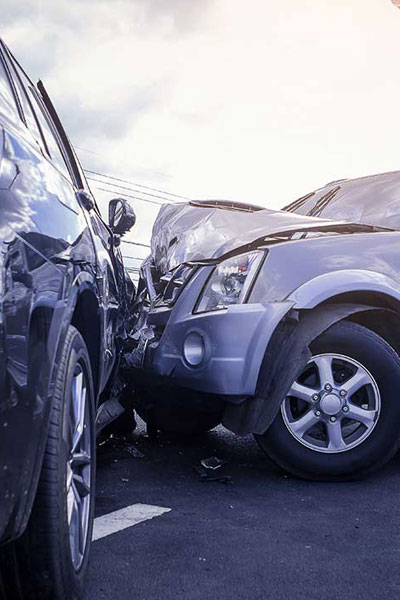
Speed Determination in Vehicle Accident Reconstruction

Why Drones are So Powerful in Vehicle Accident Reconstruction
February 6, 2026
Google Earth: Supertool in Vehicle Accident Reconstruction
February 11, 2026
Determining Vehicle Speed in Accident Reconstruction
Introduction
Vehicle accident reconstruction is a multidisciplinary field that combines physics, engineering, and forensic science to analyze the evidence facts surrounding a crash- and then to draw important conclusions. One of the most critical factors in this process is determining the speed or speed range of the vehicles involved. This may help courts determine fault, assess safety measures, and rule on certain legal aspects. Speed estimation can utilize physical evidence, mathematical processes, and even digital data. This article outlines key methods used by experts to calculate pre-impact speeds, drawing from established forensic techniques.
Skid Mark Analysis
Skid marks are among the most common pieces of evidence at accident scenes, formed when tires lock and slide across the pavement due to hard braking. To estimate speed, investigators measure the length of these marks and apply the skid-to-stop formula derived from the principles of friction and kinematics. The basic equation is:
v = sqrt{2 *μ*g*d}
where v is the initial speed, μ is the coefficient of friction (typically between 0.6 and 0.8 for dry asphalt), g is gravitational acceleration (32.2 ft/s²), and d is the skid distance. Adjustments are made for road conditions, slope, number of tires leaving marks, and other factors. This method provides the speed at the onset of braking, not necessarily at impact. However, if the vehicle did not come to a stop at the end of the braking, additional components are needed and added to the equation.
www.chicagolawyer.com
Yaw marks, which occur, for example, when a vehicle loses control after taking a curve too fast, can also be analyzed using similar principles, incorporating the radius of curvature and other information to estimate speed along a curved path.
www.northwestern.edu
Vehicle Damage (Crush)
Analysis
The extent of vehicle deformation, or crush, offers insights into the energy absorption during a collision, which correlates directly with speed. Using the crush method, vehicle accident reconstruction experts measure the depth of deformation at multiple points on the vehicle and compare it to known stiffness factors (typically factors A and B) from crash tests, such as those conducted by the National Highway Traffic Safety Administration (NHTSA).
The absorbed energy E is calculated with a relatively complex formula. By equating determining the energy used in crushing the vehicle structure, pre-impact speeds can be back-calculated. This approach is particularly useful in head-on or barrier collisions where skid marks are absent. www.performanceanalysisllc.com

3D Modeling Software to Determine Speed by Crush Analysis
The image above illustrates a 3D scan of crush damage with measurements, highlighting how deformation profiles are quantified.
Conservation of Momentum
In multi-vehicle collisions, the principle of conservation of linear momentum is applied to determine speeds. This method assumes that the total momentum before the crash equals that after, accounting for masses and directions.
For two vehicles, the equation in one dimension is:
m1v1+m2v2=m1v1′+m2v2′
where primes denote post-impact velocities. By measuring post-impact direction/speed vectors (for example, from impact position to final rest) and using delta-V from damage analysis, initial speeds can be solved. This can be combined with computer simulations for complex scenereos. Spreadsheets also simplify the number crunching.
www.physicsforums.com
Other Methods
- Debris Distribution: The scatter pattern and distance of debris and vehicle fluids can indicate reject impact speed severity, as higher velocities propel fragments farther. However, it may not be reliable for determining absolute speed or velocity.
www.anapolweiss.com
www.performanceanalysisllc.com
- Video Analysis: Footage from dashcams or surveillance can analyzed using geometry and/or photogrammetry to estimate speed by tracking distances over time. Often, when a video can be viewed frame by frame, very precise speedscan be determined.
www.sciencedirect.com
www.performanceanalysisllc.com
- Event Data Recorders (EDRs): Modern vehicles record a loop of data at all times. It continues to then delete the data unless it b senses a crash. That data is then stored, typically in the airbag control module. Some call them “black boxes”, taken from similar functions on airplanes. Data varies, but can include speed, throttle position, braking, steering wheel position, etc.- all potentially helpful in determining speeds and other relevant information.
www.jneades.com
www.performanceanalysisllc.com
Conclusion
Vehicle accident reconstructionists are often asked to determine vehicle speeds. There are many ways to do this, and some are not possible on every case. However, experts often use more than one method where possible to verify outcomes and ensure credibility in their conclusions.
Advances in technology, such as 3D scanning and AI-driven simulations, continue to refine these techniques, aiding in fairer legal outcomes.
www.wpoplin.com
www.performanceanalysisllc.com